Monday, 8 August 2011
The Examined Life
One of the more obvious manifestations of this is the increasing number of documentaries and programmes that consider various subjects under the more general label of 'popular science', an occurrence that to me seems stimulated by the public debate encouraged by the 'New Atheists' such as Dawkins and Hitchens. For me, these merely scratch the surface, much less manage to engage with the philosophical issues surrounding the basis of our moral systems in religious and scripturally based worldviews.
Examined Life (full video link) is a 2008 film that takes on the form of a Walk-and-Talk in New York with various contemporary philosophical figures, including Martha Nussbaum, Slavoj Zizek and Peter Singer. I found the film fascinating in that it operates without a final end point or narrative conclusion, instead treating each 10 minute dialogue as inclusive of itself. There is, in fact, little debate present in the film, instead with each individual presenting, effectively, a 10 minute manifesto on their worldview and way of operating both inside and outside of the Ivory Tower.
While the film has it's downfalls (particularly in the lack of direct challenge to each conversant), the documentary format interests me greatly as, perhaps, the perfect way to promote critical thinking and audience reflection on specific issues. Furthermore, a more political and less abstract set of discussions could be made, in various similar settings around the UK, with regards to various critiques of capitalism and the global political order - a set of interviews with various academics, graduate students and activists to various appropriate soundtracks.
The inclusion of graduate students or other figures above isn't just to appeal to my own ego, but rather to demonstrate and put across the ideas, as opposed to the charismatic force of the person being interviewed. While, for instance, Zizek delivers often mesmerising performances in his interviews and documentaries (check out 'Living in the End Times' available on the same website as linked above), it is his ideas and worldview we should be engaging with, rather than his personality. The background aesthetic (e.g. New York above) can be seen as a way of focussing and contextualising the imagination of the viewer, as would the use of archive footage.
This film idea strikes me as pretty exciting, even if it just fulfils the function of allowing myself, or a group, to interrogate various intellectuals in a way we are unable to purely through journal articles or books. Time to start planning, I think.
Monday, 21 March 2011
Barman, Sophist.
- How the Light Gets in Festival 2011 – This festival at Hay on Wye looks absolutely fascinating, and over 10 days is attempting to mix many of my loves – philosophy, politics, literature and music – in a huge melting pot of amazing people and more amazing words. Not least among these is Dr. Angie Hobbs, a professor at Warwick who I find absolutely fascinating, and who has an incredible collection of floppy hats. Also, Polly Toynbee. You can find out more about the festival here: http://www.howthelightgetsin.org/
- TED – Standing for Technology, Entertainment, Design, this annual event and it's subsidiaries (TEDx is organised annually at Warwick University), has spilled over into debates on philosophy and art as well as the obvious scientific element. Twenty minute talks by people who have the courage of their convictions, and above all, the will to share them and engage in the debate that ensues. Days worth of physically lazy but mentally athletic viewing available at www.ted.com, and the Warwick version's videos available at http://www.youtube.com/user/TEDxTalks, along with others.
- Michael Sandel Being a Pro – I have no illusions that my interest in philosophy is informed by my education, and so was extremely happy when Michael Sandel, a professor of philosophy at Harvard, started doing these programmes and live debates on the BBC that follow the themes of his latest book, 'Justice'. Accessible, insightful, and inviting towards criticism, you can watch them here: http://www.bbc.co.uk/iplayer/episode/b00xz0pv/Justice_The_Moral_Side_of_Murder/
- The BBC Radio 4/World Service Archives: Days worth of documentaries here. I normally get four a day of the World service documentaries, all of which manage to fit a fantastic amount of information into 25 minutes or so, meaning that I can fit two each into my walk to and from work each day. For more engaging and longer winded debates, check out In Our Time, hosted by Melvyn Bragg, or Start the Week with Andrew Marr, both on BBC Radio 4. While some people think this is a pretty heavy way to start the day, I find them the perfect way to wake up and get the brain going before clocking into another uneventful day. Check them out at www.bbc.co.uk/iplayer, or the archives on the World Service and Radio 4 sites.
- Turning up to random seminars and debates: At least once a week, I do a loop around the social sciences and humanities department of Warwick University to see what's going on. This takes some bravery, but I get a certain amount of pleasure in aiming unexpected questions at unsuspecting academics, as well as enjoying the debate my self appointed role of agent-provocateur sometimes causes. They're public forums for a reason, and if that reason is for me to question the role of history as a profession, then so be it.
Thursday, 17 February 2011
New Guitar Day - The Jangly One
Mark's website, the Jooky Guitar Emporium, found at http://jookyguitaremporium.blogspot.com/ , is a treasure trove for his loving creations, which happen to fit my own needs perfectly. Rough finished, off the wall, and heavily modified, the guitars he turned out are as much found art as they are player's machines. No museum required – sure they're pretty in a way, but they are also played in and feel very much alive. They also go brilliantly well with my collection of paisley ties.
The pickups are definitely a strange experience if you're used to more conventional options, having a huge dose of single coil snap and zing, while still sounding chunky enough for driving rhythmn work. They're very trebly, something I dialled down a little, while leaving enough there to keep things interesting. If you're after compressed high gain or jazzy neck pickup work, this is the wrong place, with loose old-school blues, rock 'n roll, and the lighter side of garage rock probably being the best place to direct your playing. The scale is shorter than I was used to at 25 inches, which caused a few problems at the gig, but nothing too difficult to get used to. The brash edge of the sound also sounds fantastic when attacked with some vigorous slide work, and has a Tele-ish character when playing in this style.Sunday, 5 December 2010
Emailing Chris White MP... Again
Alex
*******
Dear Mr. White,
Despite my concern that you have not yet replied to my previous email, I appreciate that you are indeed a busy man, especially with what appears to be a peaceful revolution scheduled on the streets of our glorious metropolis this coming Thursday. I hope and imagine your preparatory time is being spent staring contemplatively at the education funding motion, and considering a) the importance of the bill, b) how it will affect your responsibility to your constituents and c) the three line whip which is surely attached to your free and public voting behaviour. Your rather romanticised choice, then, lies somewhere between going down in history in Hansard as the guy that rebelled, or taking your career and isolated interests as having priority.
On the off-chance that you choose to address the concern of your constituents, I must how it is, exactly, that you intend to represent your constituency despite a lack of contact with its residents?
As I noted before, I have little knowledge of your private affairs, but thought you may be interested in hearing about the situation of one member of the big society who, I am proud to say, has done relatively well despite adverse circumstances.
Indeed, despite the lack of priority placed on funding the social sciences, I have been lucky and persistent enough to reach the level of PhD researcher in politics, as I hope was obvious given the content of my previous email. However, in order to fund this, I have resorted to working part time, detracting from my research, on a wage which is not considered by the government to be high enough to live on over any great period of time. Given the number of people in my situation - particularly in a town with a high student population - I am concerned as to the measures you are taken to combat the widely acknowledged tax evasion of large companies such as the Arcadia group and Vodafone.
As we are now all members of the big society, I am of course not considering this in the light of my own personal financial interests, but rather those of the children I don't have yet. Indeed, it is possible that your children, if you have them, may find themselves in a similar situation, as will the children of the policeman that will probably give me a jolly good rap on the head with whatever weapon he sees fit to use on Thursday afternoon.
Of course, my expectation that you will choose to represent the people, as opposed to the party whip, is not high, particularly given your record of representation on proportional representation voting systems. However, I hope you at least find the time to reply, as the current electoral system is liable to see you returned to Parliament for as long as you see fit, giving you more than enough time to occasionally address the concerns of the society you represent.
Mr. White, I look forward to your reply. Should you see fit to meet me personally, you will in all likelihood see me in the middle of a police kettle on Thursday wearing a T-shirt outlining my right of Habeas Corpus and generally making a little bit of an inconvenient racket. I hope your hearing has not degraded the way your political foresight evidently has.
Yours concernedly,
Alexander Hoseason
Wednesday, 1 December 2010
Bringing the Noise - DIY Microphone
It's capable of some pretty epic feedback, and I haven't tried singing with it yet, but it has that lo-fi easy to drive sound that should be absolutely primo for some desperate sounding blues or old-school punk. Let me know what you think.
By the way, the total cost of this was £1 (I was given the phone and the cable was lying around the house). Not bad, all told. As it stands, this is pretty much the extent of my electrical 'knowledge', as opposed to my brother, who to my eternal pride is now a fully qualified helicopter-fixer-guy. He probably would've made this video with less feedback, anyway :)
In other news, apologies for the beard. It was a dare.
Saturday, 27 November 2010
Homemade upright bass - The Diddley Bass
Over the last few days, I've been listening a lot to Seasick Steve and various other players of the 'Diddley Bow', a simple form of guitar that most often has one or two strings. It looks and sounds something like this:
I figured that surely it was possible to make a bass version, and so took a trip to the nearest Homebase (a hardware store) to pick up the parts for mine. The hardest bit, apart from screwing in the bolts without a drill, was probably drinking the 3 bottles of beer required to make it. It ended up looking like this:
I currently use a screwdriver and a bottle of Peroni as a beater and a slide, respectively. It's a bit quiet, so I'm going to try and fit a pickup when I get a chance. The 'bridge' is a bottle of Old Speckled Hen, and the 'nut' another bottle of Peroni. I'll upgrade to other bottles to experiment later - rumour has it that Jack Daniels offers the best 'tone' ;-)
It's 'tuned' to F#, but hopefully when I get something that isn't 'borrowed' fence wire, it'll be easier to adjust. I might get a bass machine head to make that particular pain in the arse easier.
This machine kills any pretense at skill :)
Saturday, 13 November 2010
Education Funding Concerns
Saturday, 6 November 2010
This Connected Life...
One of these:
and one of these:
So from the top, that's a Sony e-Reader, an Asus netbook, and an HTC Desire Smartphone. I've long been an advocate of keeping my various electronic devices separate, on the basis that hardware failure spells disaster and I'd rather not lose all of my important files/data etc. However, the growth of cloud computing and data storage means that I'm more willing to invest in these little bits of technical wizardry.
As a student, I hope that these will make my life easier, particularly given the huge amount of books and photocopies that I used to carry around. This isn't an advocation of any one particular product, but rather the approach as a whole. While the past 5-6 years of studenthood have left me with a dodgy back after carrying one too many textbooks around with me, I'm now able to ditch my previous reliance on printouts of .pdf files and hard copies for a satchel loaded with snazzy (and significantly lighter) electronic gadgets.
Even more important is that documents now synchronize themselves across the devices - My essays are automatically converted and loaded onto all 3 devices at the touch of a button, and monitor-induced headaches are avoided by the use of the reader's paper-like screen. Even more exciting is the fact that at 8am every morning, my bedroom becomes a firework display of electronic life, as my phone downloads any new emails or text messages, and the laptop updates the reader with various rss feeds from news sources across the world. The essays on the laptop automatically synch with those in my dropbox account, and the radio kicks in to wake me up.
There are limits to how far I'm willing to take this, of course. For instance, I sold my digital photography equipment in an attempt to use film more, and I still record music on an isolated machine. But still, it should be an interesting experiment, and there's always the snooze button if I decided 8am is too early...
Wednesday, 13 October 2010
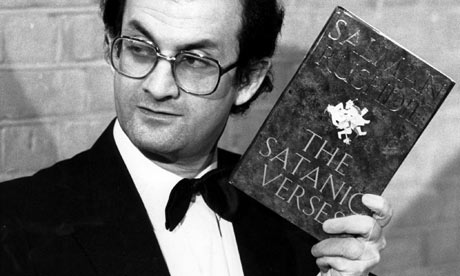
Controversial Words: Why You Should Read The Satanic Verses
The book, hopefully, is familiar, but unfortunately the numbers that have read it are dwarfed by those who are aware of the huge controversy that surrounded the book, leading to the Ayatollah Khomeini's issuing of a fatwa for the death of Rushdie, and his subsequent disapearance from public life. The issue surrounded Rushdie's portrayal of a character in the book, who resembled Mohammed, as a secular and base character, quite apart from the privileges bestowed upon him by Islam as a whole. It is far from the only controversy that Rushdie has courted, the second most memorable being his portrayal of Indira Gandhi in his (to my mind) opus, Midnight's Children.
My choice of book was guided largely by my belief that many who had criticised and discussed the book, in much the same way as the discussion that surrounded the infamous Danish cartoons of Mohammed, had not read the book, much less have a grip upon the substantive ideas that it presented.
I will admit to being a huge fan of magic realism, from Marquez and Llosa through to Bulgakov and Kundera, and believe that Rushdie is a master of the form. His novel inverts the usual relationship of the spiritual and magical to the mundane, with key religious events approached with a secular, human sobriety, and everyday life examined through a lens seemingly smothered in fairy dust. Indeed, the twist that facilitates the interlocking narratives of the Satanic Verses is nothing if not an entirely human foible, drawing attention to the strange mix of lofty ambition and day to day struggle that puts humans somewhere between angels and insects.
This, quite apart from the offence caused, is a topic of great pertinence at the moment, with the Christian equivalents perhaps being portrayed in the 2005 film Son of Man, that depicted Jesus as a political figure, and the recent novel The Good Man Jesus and the Scoundrel Christ by Phillip Pullman, that demonstrated the fundamental weaknesses of whatever is human. However, it should not be the existence of such works that provokes controversy – religions have never had a problem finding suitable heretics – but rather the content of the ideas themselves. The debate surrounding the Satanic Verses seemed to contain little debate as to the ideas, but rather the political issue of the fatwa, when the opposite should have been the case.
While The Satanic Verses is hardly a textbook on Islamic thought, it is most definitely worth a read as a way of approaching the debate concerning the representation of Mohammed and Allah in Islam – a debate which goes back to the Ottoman Empire and before (for another fantastic book on the subject, set in Istanbul, check out My Name is Red by Orhan Pamuk). Indeed, not reading it because of the controversy is doing the spirit of public debate a disservice. Above that, though, it is a masterful piece of fiction, and shouldn't that be reason enough?
Saturday, 2 October 2010
Acceptable Language and the Expulsion of the Roma
Thursday, 30 September 2010
Fairground Photography - Part 1
Wednesday, 29 September 2010
Some Thoughts on Art, Video Games and GOG.com
Wednesday, 22 September 2010
Progress(ion): Conceptual Sketch
Monday, 13 September 2010
Symbols and the Blues: Who is BB King?
Sweeping, perhaps, but even after my hangover has cleared, I'm pretty ready to attempt to back it up. For lovers of the blues, even those that don't consider BB King 'up there', he is considered a physical and metaphorical monument to both blues music, and its traditional subject matter. Moreover, he is perhaps blues music's No.1 ambassador, still performing innumerable dates as he reaches the ripe old age of 85 or so. In terms of recognisability, many will have a familiarity that at least extends to his name and his famous guitar, Lucille, if not the depths of the music itself.
So who, or just as importantly what, is BB King? To back up such a statement makes it necessary that there is some unique quality that is BB King, that makes him unlike others before or since. It is this quality, rather than the name, that makes the venerable Mr. King inimitable, and although I can only attempt to back this up on my own terms, it'd be interesting to see how others perceive the other great icons of music and stage – Marilyn Monroe, Frank Sinatra etc., to understand what makes that particular person a monument, a symbol in lives across the world.
Personally, I'm inclined to argue that it is, above all, his persistence that has made its mark on my understanding of blues music. While blues has remained a relatively static form over the years, young 'uns such as myself approaching the guitar for the first time might still be overwhelmed by the variety on offer, from Robert Johnson through to Joe Bonnamassa. Moreover, it is unlikely to be an original choice, with many fledgling players being pushed toward the blues as a basis for further development. King's persistence, from the post Muddy Waters days through to the present, combined with his undenied authority over the form, present a kind of anchor in a calm, but vast sea of opportunities.
The persistence occurs in other forms too. While it is increasingly popular to name particular chords or styles after artists, such as the famous Hendrix Chord, King was one of the earliest to receive the accolade, with people dubbing the upper registers of the second-position minor pentatonic 'the BB King box'. With 5 notes, it's both easy to navigate, to experiment with, and to expand. Upon picking up my first electric guitar (a 335 style archtop, of course), my acoustic-trained fingers skipped straight to the BB King box as a way of trying out that style as soon as possible. It isn't uncommon to hear the claim that you can tell BB King from other blues artists by an average playing length of 3 or 4 notes, and while this may be true for others, such as Clapton's 'woman tone', the BB King sound has been drilled into us far more thoroughly. It's also relatively easy to reach, using a minimum of effects wizardry. All of these things should, technically, make BB King's music easier to play. Nothing could be further from the truth.
While searching for ways to start absorbing blues music, I came across several mentions of a BB King album named 'Live at the Regal'. The recommendation wasn't a low level one either – both John Mayer and Eric Clapton claim to listen to 'Live...' before performances in order to set the atmosphere of their own stagework. Perhaps as expected, 'Live...' is a masterclass of blues guitar, incorporating the fluid bends and impossibly nuanced vibrato one has come to expect. More than that though, it demonstrates King's rapport with the audience, demonstrating the way that he clicks with their worldview through conversations between songs, as well as the music's subject matter. His presence on stage may have transformed between 'Live...' and his current status as Blues' elder statesman, but that rapport hasn't disappeared just yet, and I very much doubt it will disappear over the course of his latter years.
It may be possible, some day, that someone comes along who can play like BB King. Indeed, enough guitarists have taken and perfected his technique, and it is probably only the purists that can claim to hear the difference. But in claiming that someone can be BB King, we are overstating the importance of the music, and ignoring the fact that to many blues players across the last 50 or so years, including myself, he remains a person who in his manner rather than his performance, has developed a form of Grandfather relationship that extends far beyond the music.
While this is a brief piece, I hope it explains my reasoning, and I hope you go and buy a copy of 'Live at the Regal' for yourself. Listen to it on a good pair of headphones in the dark before taking to the stage yourself, and if I'm in the audience, you can come up to me afterwards and tell me that noone, in the past or present, will ever replace BB King.
Long Live the King.
Tuesday, 7 September 2010
Progress(ion): A 12 Bar Blues
Saturday, 4 September 2010
Falling in Love
Online games are strange beasts, and I was never quite sure what the point was to World of Warcraft and Team Fortress 2. That and they are, in many cases, populated by complete bastards. In a peculiar way, it appears that many of the people that embrace the social nature of the internet through these games do so out of a fairly vicious competitive streak. After you've levelled up and got the best gear, or perfected a map strategy, you exist largely for either competition or bragging rights, deriving pleasure from the ability to deny the same feeling to others (BOOM, HEADSHOT!)
It is fairly safe to say that LOVE, Eskil Steenberg's one man mission against all that is continuous and rigid in modern online gaming, is different. That's hard to get used to at times. But it is, and it'll take you to places that you can't possibly imagine after spending years gulping down the victory gin that other games send your way. When I first came across LOVE, about 6 months ago, I saw it described, derisively, as 'Communism: The Game'. Being a politics student doesn't leave me automatically hostile to the idea, and in fact intrigued me further. Discovering that the game would be free to play for a time, I decided to give it a try.
So, is it Communism in digital entertainment form? Yes, no and maybe. The basic elements of LOVE consist of cooperating with other players (!!!) to build a settlement that can survive against several tribes of artificial intelligence that are doing roughly the same thing. You can move, shoot, and use various tools acquired from around the world to build, smooth, retexture, reroute, create power grids and defences, artillery and other means to facilitate your colonisation. The world is procedurally generated and persistent – seas rise and fall, settlements are wiped out and rebuilt, and hills rise toward the sky over time, ensuring that returning to the game world is both familiar and strange. Your base, if you're lucky, may still be there, but forests may have advanced or retreated, and glaciers may have grown or shrunk. Indeed, there was recently some server downtime as Eskil updated the tectonics system. Tectonics?! This is a far cry from the comfortable consistency that allows the players of other games to put down roots and stake their claim to greatness in one or more digital realms.
The biggest fascination for me, though, was the fact that the game hasn't been beaten yet. I was always put off by the knowledge that in online gaming, someone would always be ready to hand my arse to me at the tip of a hat. In LOVE, that doesn't happen. You build together and fight, not against a specific enemy, but against nature itself. This is where the communism analogy breaks down. Allowing for some politics geekery, Marx claimed that communism could emerge properly once man had conquered nature. On any of the LOVE servers or worlds, this hasn't happened yet. Even the AI, with its varying aggression toward the player settlements, is easier to understand as a force of nature, and a horribly efficient one at that. The world wants back what has changed, and this reclaimation happens with horrifying efficiency, leading to the saying on LOVE forums that 'home is where the artillery hits'. The survival of a base for more than a 24 hour period is considered an achievement here, and when it starts raining, its time to get to higher ground because without the right tools, the water is deadly. A settlement I joined once was unable to get hold of the essential configuration tool, leaving us powerless and struggling to survive, frantically shouting over a teamspeak server to coordinate some kind of plan that would save us from being swallowed up by a stormy armageddon.
As it happens, the lack of a configuration tool was a bug, which LOVE still holds in spades. This is perhaps unsurprising given the one man nature of the project, but it was at times like that the geographically disparate group of people I was playing with came together as a unit, and even moreso, my respect to Eskil went through the roof. Even the intimidating graphics, a fair impression of the LSD loaded bastard love-child of Escher, Monet and Van Gogh, create an atmosphere more comparable to a work of traditional art than electronic entertainment, and are a far cry from many of the games that independent designers consistently compromise on to push the project out.
While the free weekend won't last forever, LOVE remains well worth the 10 Euro/month cost of entry, warts and all. It definitely won't be for everyone, but it is worth a shot for at least a month, just for the fact that your ideas of digital entertainment might be blown out of the metaphorical water. Communism: The Game might just give you a glimpse of utopia. It can be found at www.quelsolaar.com.
Monday, 15 February 2010
A Frame In Time - Annie Leibovitz at the National Portrait Gallery
A Photographer’s Life at the National Portrait Gallery charts her work, for the most part, from the early nineties through to the present day, a disappointment for those who may have justifiably wanted to see the photographer’s earlier work. However, relatively little is made of the massive scale commercial and advertising work she has become famous for, instead sticking to more personal portraits, such as those taken for Vanity Fair and various smaller scale commissions. There are a fair few standard studio portraits among these, which is somewhat of a disappointment for those familiar with the visual flair usually demonstrated. By her own admission, Leibovitz is far from a great studio photographer – the lighting is well done, but unoriginal, and the studio limits her genius for on-location composition, but those who have come for the famous faces rather than the quality of the images will be suitably impressed by the plethora of names and faces on display.
But moving beyond these images reveals a Leibovitz that is as as original and exciting as she ever was in the drug and alcohol fuelled early days of Rolling Stone. The shots of multiple people in particular are a tour-de-force of every way a photograph can reveal the relationships between people - Johnny Depp, dressed in dark clothing, lies between the legs of a naked Kate Moss on rumpled sheets in a moment of perfect intimacy. Patti Smith shares a delicate, but melancholy moment with her children. Even a photo of the late photographer Richard Avedon with his own companion – a 10x8 field camera - is lovingly crafted in every way to bring out the connection he shared with his greatest tool.
However, the greatest moments in this exhibition are the personal portraits that dot the walls. Often not bigger than 6x4 inches, they seemed to be largely ignored by the celebrity hunting masses in the gallery – who gravitated toward the 20x16 (and larger) images of stars. It seems easy to forgive a visitor for missing a tiny black and white print when it is placed beside an infinitely enthralling shot of Nichole Kidman, but these shots are the massively important (and unseen, up to this point) snaps of family and friends, and comprise everything from a grinning portrait of her dad and brother to the final moments of her dad’s and companion Susan Sontag’s life. While being small, they are just as revealing of the real Annie Leibovitz, and prove that regardless of her status as perhaps the top portrait photographer of our time, she never lost the eye for intimacy and relationships that marked her as great from the early days of her career. Furthermore, they offer a great and compelling insight into the photographer’s private life and not just her publicised work, allowing those who had become jaded with the over-elaborate commercial images that defined her public image in the last ten years a sigh of relief in the knowledge that she has not been overtaken by them.
Saturday, 19 September 2009
Newspaper Article - Paris
An early (and unknowing) contact with New Journalism - attempting to portray Paris by putting 'myself' into the report. Wanted to make this an extended piece, but I ended up working to quite a strict word limit because of the paper's small travel section. Published with a collection of photographs I took whilst there, but I haven't figured out how to limit the size or watermark them on here. I hate copyright thieves.
*******
Two days after one of my Erasmus friends told me something like “Oui Alex, you should come and take pictures this summer, Pah-ree is tres beautiful”, and I’m on a flight. I’m in full on photographer mode, heading to the home of street photography, to streets trodden by the cutting edge of photojournalism – Henri Cartier-Bresson, Robert Doisneau, Martine Franck. 20 rolls of film rattle optimistically in the side pocket of my overpacked rucksack. 18 would remain disappointed and be returned to my film fridge at the end of the trip. I had been naïve in thinking my photographers eye would last a week without being sucked into the atmosphere of the city of lights.
This wasn’t to be a week of photography at all, but rather a week of high culture, low culture and everything in between. Parties every night, galleries every day. Coffee until 5pm, and wine until 6am. And conversations throughout all this – sat in the cafes around the Louvre, in dark corners in underground bars, and in the gardens of the Sacre Coeur after jumping the fence at 3 in the morning.
I stayed at the Peace and Love hostel in the
An incredible fusion of culture and the party lifestyle is a feature of many of the great European capitals –
Sitting in the hostel bar for 20 minutes each day, I’d end up in a random conversation with a mixture of locals and fellow travellers, before sauntering over to the Louvre, Pere le Chaise, or the Arc de Triomphe. It’s easy to see why Parisisan cafes and parks became the backdrop for innumerable conversations between Sartre and his fellow philosophers, and which form the background of the photographs I admired so much while at home. The atmosphere is all consuming, as the gentle music of cafes and the large windows invite you to look out onto the street, give up on that copy of Nausea, and just watch the world go by.
Ultimately,
- Published in the Warwick Boar, 2007
Newspaper Article - Spillers' Records
********
Cardiff isn’t a city that hides its landmarks away. As you come in to the city by train, it’s easy to see the Millennium Stadium, its contemporary design standing as a motif for the modern city of the future – a mass of identical chain-fashion stores, easy-access entertainment and overpriced city centre nightclubs. However, hidden opposite the massive building site of a new, ‘exciting’, shopping experience on the Hayes, lies a true gem of Cardiff culture – Spillers Records, the oldest record shop in the world.
Established over 100 years ago, in 1894 by a certain Henry Spiller, Spillers remains largely untouched by the clinical, hospital-like atmospheres of larger chain stores such as HMV. Remaining independent throughout its history, the store, owned by the enthusiastic Nick Todd, hides the dream of any true music aficionado behind its simple red façade. Wallpapered in posters for gigs large and small, past and future, the racks hold row upon row of CDs, catering from a wide variety of music tastes, but leaning toward those who are as enthusiastic about music as Spillers employees – and that is, to put it bluntly, very. Enquiring about whether or not they had an album by instrumental rockers Mogwai, Nick’s daughter greeted me with genuine enthusiasm, apologising first about disturbed stock deliveries due to the band’s record label moving base, before telling me that if I was a fan I should check out a gig at Cardiff’s Clwb Ifor Bach that night for a band that had a similar sound. A similar depth of information was thrown the way of the wide and varied clientele, from a suited gentleman asking about Nina Simone recordings to a fluorescent-vested workman inquiring after Iron Maiden DVDs. In Spillers, everything from local scene gossip to the tectonic movements of worldwide rock superstars flows between enthusiasts with a keenness that leaves the homogenous consumer mass miles behind, preferably somewhere they can purchase their soulless aural novacaine from a pre-pubescent teenager in a Zavvi T-shirt. I don’t want to be greeted with (at worst) a grunt, or (at best) a semi-enthusiastic offer of a storecard. I want to ask for a recommendation, be handed a disc, and be told ‘you need this album in your life’.
Unfortunately, the shop hasn’t enjoyed plain sailing over the last few years. With the threat of rent increases, and unfortunate placement facing the new St. Davids 2 development, there have been multiple instances of this fantastic monument to music being permanently closed. However, support from both the local area (particularly students), and from the upper echelons of rock stardom have, so far, managed to keep Spillers in business. The Manic Street Preachers have registered their support, as well as Columbia Records, and closer to home, politicians in the Welsh Assembly have encouraged support from the wider community for the store. For the moment, rent increases have been held, and so Spillers remains in business. As the name of the highly successful facebook group states, ‘justice for music, innit.’
The wide scale regeneration efforts in Cardiff have been largely successful on a commercial level over the last few years, turning the city from one that was declining into a bustling multicultural city of the future. However, while walking around it’s easy to believe that in the process, it may have already started to lose its identity. To many people the city doesn’t show any level of uniqueness through its main shopping street, or the millionth Oceana. However, along with the fantastic undercover market, the beautiful gardens of the university, and the castle, there’s Spillers. There has always been Spillers. And hopefully there will always be Spillers, fighting the impersonality of the internet age with a charm and charisma that isn’t available in .mp3.
- Published in the Warwick Boar, 2008
Newspaper Article - Travelling in India
Again, an attempt at a magazine style story cut short by word limits and my wanting to show off my photos on the same page. No chance to even mildly give justice to the 2 and a half months I spent in the country, which I fell in love with.
*********
“Very nice place, very good,” says one of my pupils matter-of-factly, resorting to one of the innumerable catch-phrases that Indian people love so much. I was slightly wary, remembering that I had been told something similar about Jaane Tu Ya Jaane Na, a Bollywood blockbuster that had proved to be the most painful 3 hours of my life. Nonetheless, I rush over to the bus station with a friend, and get the next state bus out of town, onwards to one of the many spontaneous adventures of my time in
I claim it was spontaneous, but in many ways these odd weekend trips out of the city to random exciting locations were entirely predictable. Spend hours on a packed state bus with fascinated Indian people staring and mumbling in Gujarati or Hindi, stumble off to be assaulted by rickshaw drivers, and spend a couple of days getting hopelessly lost in one of the most overwhelming cultural experiences of my life.
This particular trip, to a ruined Muslim city about 50 kilometres northeast of where I was staying at
I had ended up in
Developing familiarity with one city also had definite upsides – shopkeepers got to know me and my workmates, rickshaw drivers didn’t try to rip me off as much after I told them that I lived there a few times, and I always had someone to show me something new in the crazy world of extremes that is a modern Indian city. I ate meals in luxurious all-you-can-eat restaurants, and had coffee with Islamic cloth merchants in the old town’s market, just after bombings had rocked the nearby city of
This immersion was one of the most valuable parts of my trip. After the relatively sheltered and chaperoned couple of weeks, I picked up a smattering of Hindi, Gujarati and Arabic, allowing me to venture out and have broken conversations with any number of locals, many of whom seemed absolutely fascinated by my blonde hair and blue eyes. It also helped me understand the absolutely religious nature of India – after almost getting hit by an oncoming elephant following a dodgy overtake in a rickshaw, my driver turned round and grinned at me. “Al hamdu lill’ah”, he shouted back, somehow avoiding the hordes of traffic ahead while looking back at me – “If God wills it”. Every week there seemed to be another Hindu festival, from letting off firecrackers on the beaches of
A word of warning though. Things in
Any visit to
- Published in the Warwick Boar, 2008


.+A+12+Bar+Blues.jpeg)